




 Performance Communications | August 20, 2018
I love golf. I’m not alone. There are loads of us – it’s the eighth most popular sport in the world, after all. That’s why it was so disappointing to see one of the game’s great events – the US PGA Championship – mired in broadcasting controversy.
Some might consider it the lesser of the four Major tournaments, but it’s still one of a quartet of titles that, in the history books, marks out great from good. Yet, the way in which it was broadcast by online platform Eleven Sports left many viewers unhappy.
It’s the latest example of fans losing out as the rights to our favourite sporting properties are traded with scant regard for those watching. Should this continue, the rights holders and broadcasters might find our patience wears so thin, we no longer watch at all.
Eleven Sports, who?
Whether issues with the feed on the channel’s Facebook page or the broadcast cutting out as the Champion-elect, Brooks Koepka, tapped in for victory, the UK coverage of the US PGA drew plenty of criticism.
It all began before the tournament started as people complained online that they didn’t know where or when to watch. National newspapers even wrote articles explaining how to tune in.
As it turned out, as well as being available on its Facebook page, coverage was also just a fill-in-your-credit-card-details-here away from a free trial through the Eleven Sports website. However, in the end, the confusion surrounding how to watch and the need to provide personal data, anecdotally, meant only the most hardcore golf fan bothered.
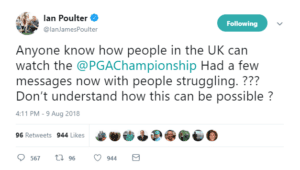
Remarkably, this resulted in star golfer Ian Poulter taking to Twitter after his first round to clarify what was happening.
This was made all the more frustrating as everyone should have been immersed by Tiger Woods roaring once again on a Major Sunday, only to come up shy of sport’s greatest comeback.
Or, better still, revelling in the achievements of another, much younger, American – Koepka – who rubber stamped his emergence as one of golf’s brightest young stars with a third victory at the top of the game in 15 months. Whether an armchair fan or ardent follower, Sunday in St Louis was inspiring to watch.
The power to inspire
Golf, like all professional sport, inspires. Whether as a means to get out and exercise, meet new people or pursue a career, it changes lives.
For most of us, our experience of the best players comes through the television and, like so many, I grew up glued to the biggest golf tournaments; staying up past my bed time to watch the Masters, spending summer days glued to the Open Championship and tuning in every two years to watch the European Ryder Cup team put the Americans to the sword, it was these moments that sent me out to play.
Yet, I fear the next generation of golfers could be lost to a trend enveloping the wider sporting world.
The battle for hearts and minds
It has long been forecast that linear broadcast TV was not long for this digital earth and Eleven Sports’ first foray into golf was the latest example of a new kind of service. Golf is not the only culprit, with high profile examples such as cricket, tennis, Formula 1 and other such terrestrial staples having all but disappeared behind a paywall.
Previously, most of us could get our heads around paying a single subscription as Sky hoovered up UK sport’s crown jewels, but now multiple subscriptions are required to see everything. Not only is that convoluted, it’s pricey too, and with so many sports now too costly or difficult to watch, this could have an effect on participation.
The self-perpetuating worst case scenario is that not only will participation drop, but fewer players will mean TV audiences follow suit. And round it goes.
Who’s to blame?
You can’t blame rights holders for taking the money. They have a duty to fund the sports they are custodians of, and that’s not cheap. Plus, if broadcasters are willing to pay such a high price, why turn it down.
However, that word – custodians – is important. TV companies are not beholden to sport. They have a product to sell and are under no obligation to grow the game. In this case, the PGA of America had a duty to not merely take the money, but to ensure the best presentation of the sport to the most people. That’s how you grow the game.
That’s what made the decision to give the US PGA Championship to Eleven Sports so disappointing, as the platform was not up to the job technically, or by way of its presentation. Two men huddled in a booth back home with a pair of roving reporters on the ground is not good enough in an age when Sky and BT set a much higher bar.
I get that digital broadcasters are the future and I’m not looking to stand in the way of progress. Viewers on Eleven Sports saw the golf and, once they knew where to look, did so for free. However, the absence from TV for those without the wherewithal to cast or plug into a screen was alienating. It is there that rights holders must take more care.
What next?
Broadcast TV isn’t the only way to encourage kids to get out and play sport, but at a time when young people are leading increasingly sedentary lives, inspiring them to get out and play sport has never been more important.
You cannot stop the march of progress. The way we consume sport around the world will continue to evolve at our expense. However, rights holders must remember the joy fans feel when watching the best sporting action and safeguard that feeling for our kids.
With less opportunity to watch comes less inclination to play. Before long, and if rights holders and broadcasters alike are not careful, there might be nobody left to watch or play at all.