



 Performance Communications | نوفمبر 10, 2026
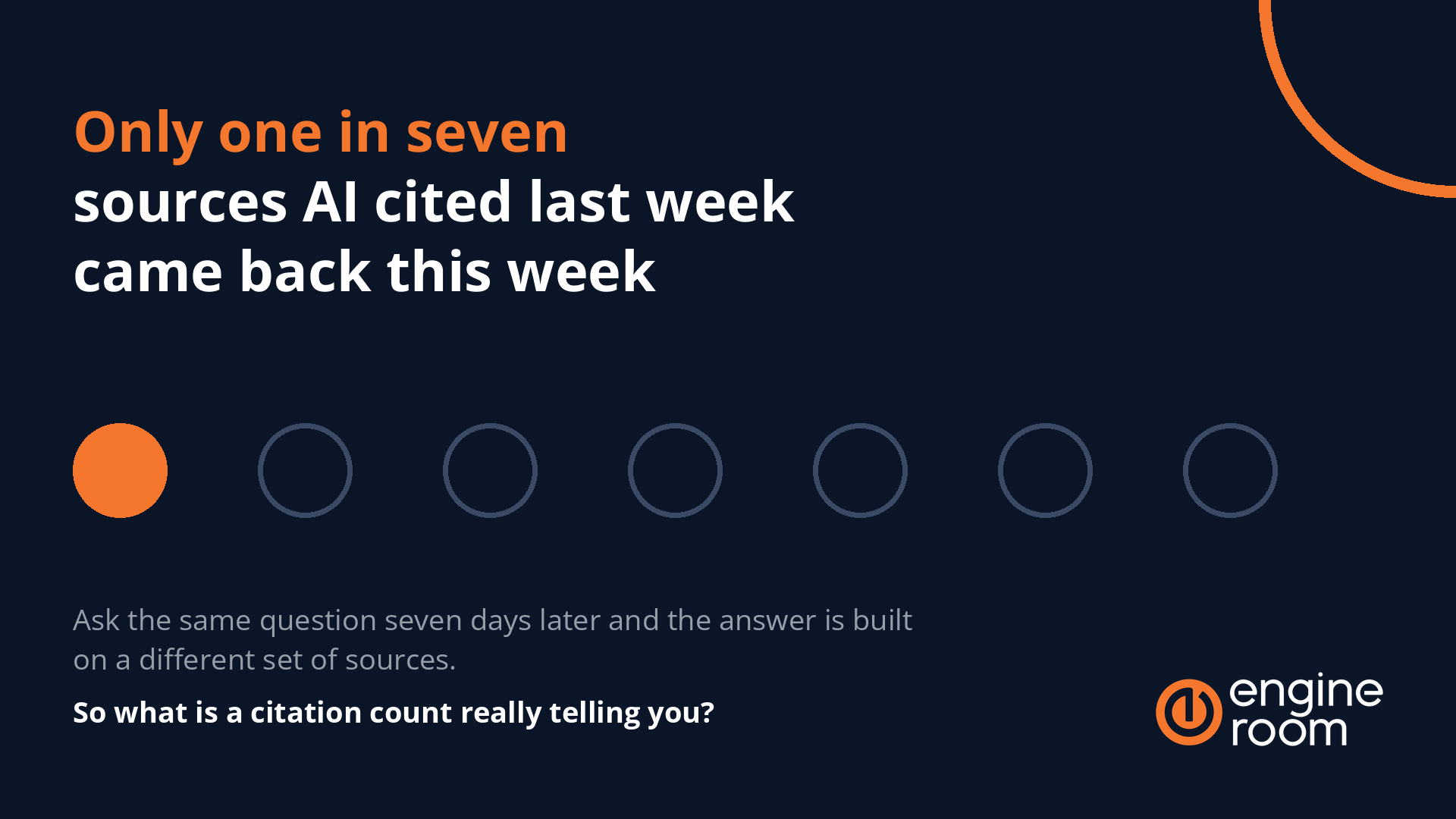 A recent study by AIVO says citations are noise. Run the same prompts three times, and it reports that the cited sources change 95.8% of the time. They then go on to identify that the brand recommended (after multiple follow-up questions) changes only 14.6% of the time.
The implication is that brands measuring how they perform in this new AI conversation should pay less attention to how often their website gets cited, and more to what the tools are saying about their brand.
We tested the AIVO study on 12 weeks of our own car-buying journey data to see if the hypothesis stood up. The citation claim holds up. The recommendation claim is one we don’t always see in the OEM space.
What we measured
Engine Room asks the same 1,200 UK car-buying questions every week on four assistants: OpenAI, Gemini, Perplexity, and Google AI Overviews. It reads every answer, identifies the brands and models named, and records sentiment and recommendations.
We used 12 weekly runs, from 2 August to 18 October 2026, with about 57,000 answers.
What we do not know about the AIVO study is what its prompts were or which sectors they covered. Buying a car is a long and complicated purchase journey, so we would not expect the data to line up exactly.
Citations are noise
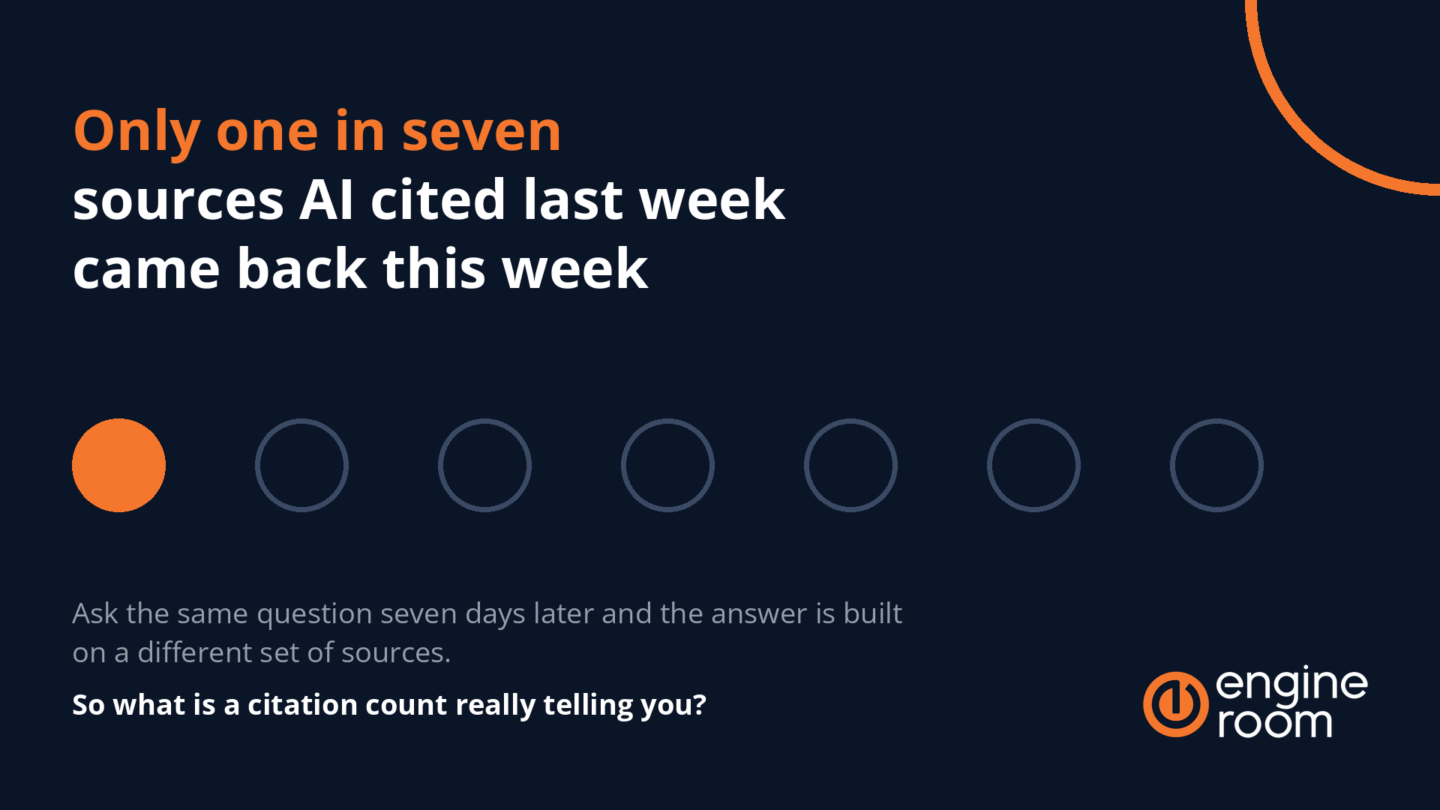
In Engine Room data, the same prompt returned a different set of cited sources from one week to the next in 99.5% of cases, consistent with AIVO’s 95.8%.
Our runs are a week apart, not back to back, so some of this is drift. Either way, a number that changes 99 times in 100 cannot show whether any change a brand makes to get its website cited more often, such as updating web content or earning more links, had an effect.
So, an OEM counting citations has only a poor approximation of how visible the brand is to the consumer reading and acting on the answer.
The opening shortlist is broad and shifts every week
Across the answers to those 1,200 prompts, we can see the AI tools helping car buyers build a shortlist. Asked what the best family car is, an assistant works out more about the buyer and puts up a list of brands and models to consider.
Not all mentions on that shortlist are equal. Some brands are simply listed, others are singled out and recommended. We track both for over 70 OEMs and hundreds of models in the UK, so you can benchmark across whichever market segment matters.
Taking three weeks at random, one prompt answer shortlists about 5 brands, but across three weeks, the same prompt shortlists about 8 or 9 different ones. On average across all 1200 prompts, only 19% of shortlisted brands and 7% of recommended brands appear in all three weeks (9% and 4% for models). That is far steadier than citations, but it is still a list that rotates. A brand on the shortlist this week is not safely on it next week.
The prompt matters
How consistent the shortlist is depends on the question being asked, from 11% of shortlisted brands for finance and leasing questions to 34% for vans and pickups. For an OEM, that is the difference between a battleground worth defending and one that is still being fought over every week.
| Prompt type | Shortlisted brands in all 3 weeks | Recommended brands in all 3 weeks |
|---|---|---|
| Vans and pickups | 33.9% | 12.1% |
| All prompts | 19.1% | 7.2% |
| Cost of ownership | 13.1% | 5.0% |
| Finance and leasing deals | 11.3% | 3.3% |
By category, LCVs are steadiest (30% of Shortlisted brands present in all three weeks) and Design/Style least steady (9%).
Questions naming a specific type of vehicle are the steadiest. Finance and leasing questions are the least steady, probably because the deals themselves change week to week.
What holds steady
Here is the part that matters for anyone trying to manage a brand. Individual answers churn, but a brand’s overall visibility is fairly stable. That stability gives brands a baseline they can work against.
At the top of the sales funnel, a top-20 brand’s share of shortlists moved by 4% from one month to the next, and its share of recommendations by 8%.
The noise in any single answer averages out, and it averages out far better for brands than for citations. That stability does not mean a brand’s position is fixed. It means a brand’s position can be measured and then acted on.
The first step is to understand what the AI tools are saying about you and your models.
Next, identify the gaps: the questions where you are missing from the shortlist, or listed but not recommended. Then engage the media those tools listen to on those topics, so the conversation shifts in your favour. Because the background is steady, the results are visible. If your share of shortlists moves by 10% after a campaign, that stands out clearly against a background that normally wobbles by 4%.
What this means so far
Our data backs AIVO on citations, and it describes a different stage from the one its recommendation figure measures.
- For a single prompt, cited sources are not a stable score.
- The opening answer is a broad shortlist that rotates week to week, and how much depends on the prompt.
- Track share of shortlist and share of recommendations across many prompts, and test any measure for noise before you manage against it.
We have not tested whether more citations lead to more recommendations. That decides what GEO (making content easy for AI to find and cite) are worth, and we are not drawing a conclusion….yet.
In the meantime, if you want to know how often the AI tools put your brand on a buyer’s shortlist, and how often they recommend it, that is what Engine Room was built to tell you. We can show you where your brand and models sit against the rest of the UK market. Get in touch and we will walk you through your own data.