




The Warehouse, 47-49 Cowleaze Road, Kingston Upon Thames, KT2 6DZ
+44 (0)208 541 3434

The cost of a football ticket

Performance Communications Author Image Performance Communications | فبراير 16, 2016

“We’re sorry” read the back page of Metro last week. The grovelling apology resulted from the proposed hike in ticket prices announced by Liverpool FC.

The furore surfaced when Fenway Sports Group (FSG) – Liverpool’s owners – revealed highly controversial plans for a £77 matchday ticket in the redeveloped main stand and season tickets of £1,029, a significant increase on the current £59 and £869 prices.

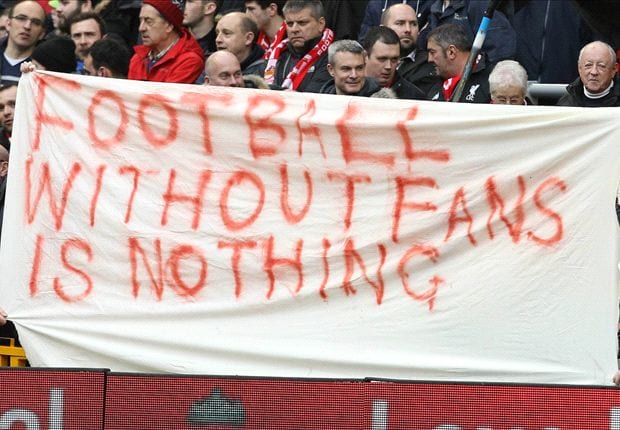
Quite rightly fans were furious and 10,000 of them, including one Jamie Carragher, walked out of Anfield 77 minutes into Liverpool’s game against Sunderland. Immediately Liverpool’s 2-0 lead evaporated and a lowly Sunderland secured a valuable point with two late goals. All because of the walk out? Who knows?

But it’s not just Liverpool fans being threatened with swollen prices; clubs up and down the country and across Europe are trying their luck. It’s well documented that Arsenal supporters are asked to fork out above and beyond with their most costly season tickets and home games priced at £2,013 and £97 respectively.

What makes matters worse is the mind-boggling four-year £5.14 billion TV rights deal announced by the Premier League last year; a whopping 71% increase on the previous 2013-2016 deal.

Premier League chief executive Richard Scudamore said the money raised from the auction would be invested by clubs in making improvements to stadiums as well as “youth development and good causes”.

So in truth football clubs don’t need any more revenue from tickets sales, they are already suffocating in a sea of gold.
Which is why the news of FSG’s u-turn on ticket prices is music to the fans’ ears. For too long football clubs have forced fans to dance to their merry tune thinking they will just keep coming back for more.

Football clubs – or global brands as we now like to call them – are getting it wrong. They have forgotten about the very thing that makes them successful: the fans.

Here at Performance Communications we like to think we know a bit about fans. Everything we do for our clients, all the content we produce, we ask ourselves this: would the fans be interested in this story / video / photo.

Because once one fan has seen something they like they will share with the next, and so on.

In the same way that good news travels fast so does bad which is how the 10,000 at Anfield co-ordinated their walkout.
Clearly we aren’t going to see a swathe of empty stadiums but it’s a timely reminder to Premier League clubs of the power of the fan and the reason they exist. Because without the fans what do football brands, and in fact any brand, film or reality TV star have? The answer is very little.

Simon


Related stories.

AI search success: Don’t be fooled into thinking it’s all about your brand website

Andy Francis explains how LLMs are the ultimate dinner party hosts when it comes to understanding the scrap for AI recommendations Measuring success on how many times your brand website is cited is NOT the goal in the age of AI-assisted search. Let me explain. Picture a dinner party. The LLM is taking your place […]

How electric vehicles hold the key to balancing Europe’s energy grid

Harnessing the European car parc to help provide a stable energy grid sounds like the work of science fiction, but Lindsey Reaney explains it could be closer to reality than you think One of the big challenges for electricity grids running off periodic generation sources like renewables is the issue of intermittency: what happens when […]

Six things we’ve learnt in the first six months of 2026

The face of search has changed forever and the pace at which it’s doing so is quicker than ever. At the start of the year, half of UK adults were using LLM-based AI tools to find car information. Now, as we enter H2, that number is already at two-thirds – and growing.   The era of […]

To charge for features, or not to charge? That is the question for software defined vehicles

I enjoyed my first visit to FT Future of the Car summit last month, and it got me thinking. While Software Defined Vehicles (SDVs) and connected cars were a hot topic, communicating the benefits of these vehicles to consumers isn’t necessarily straightforward. It’s especially hard when it feels like new tech is simply the enabler […]

Partnerships, Partnerships, Partnerships

Sam Mercer noticed a running theme at the FT Future of the Car Summit as the complexity and cost of producing modern cars is pushing more and more companies to work together. “Protectionism doesn’t work”. That was the clear statement from one panellist at FT Future of the Car last week. And this sentiment truly […]

Breaking Barriers

It’s not often you stop and stand in awe of sporting achievement, but Sunday morning’s London Marathon stopped me in my tracks. The sub two-hour barrier for a marathon was never meant to be beaten in competition across 26.2 miles. While Red Bull and INEOS’ 2019 event showed it could be done in controlled conditions, […]

2026 is make-or-break for self-driving cars in the UK

We all know that driverless cars are no longer the stuff of science fiction. While both China and the US have embraced autonomous technology, Aisling Fitzgerald looks at why 2026 promises to be a big year for self-driving vehicles here in the UK… This year is set to be a turning point for autonomous mobility […]

Do e-axles hold the key to the EV transition? Why EV powertrains are going all-in-one

While battery technology typically takes the role of frontman in the rock band that is the EV transition, Matthew Kirtley looks at another member of the group that could be about to take centre stage… According to a recent report from Automotive IQ, the total value of EV powertrains produced worldwide is projected to more than […]

Be Bold.

It’s time to come off the fence:


Message us