




 Performance Communications | مارس 9, 2017
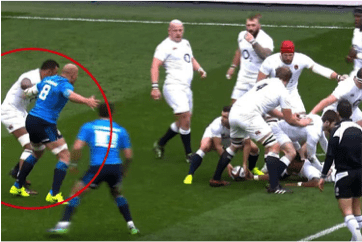
Newspapers, web articles and Twitter exploded this week following the confusing and unusual tactics of Italy against England in the RBS 6 Nations Championship on Sunday. Whilst most of the 80,000 attendees at Twickenham and people in front of their television screens were screaming for offside, the Italians exploited a loophole in the laws of rugby – no offside line is present unless a ruck (a contest between at least one player from each team for the ball after a tackle is made) is formed.
As the Italians did not compete for the ball, no ruck was formed, and the Italians could move their defence to whichever part of the field they pleased. In this case, blocking off all passing options for England’s scrum half.
Cheating? Clever? Unsporting? A blog for another time perhaps but it certainly got debate swirling at Performance Towers, as to what were the best (or worst, depending on how you look at it) instances of law-bending in the history of sport.
Italy’s tactics, 6 Nations 2017
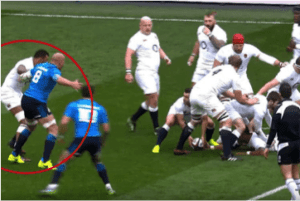 Seeing England scrum-half Danny Care looking around flummoxed when retrieving the ball from a tackled team mate, is one of the strangest sights on a rugby pitch.
Italy cleverly manipulated, on several occasions, the rule that an offside line is not present unless a ruck has been formed, allowing them to block off passing lines between a 9 and his back line (which would usually be seen as blatant offside, and punishable by a penalty and potentially even a yellow card).
This tactic confused England for the entire first half, before using their pack more efficiently to drive through the soft underbelly of Italy’s defence. They even attempted the tactic themselves at times in the 2nd half, to the enjoyment of the Twickenham crowd.
Steve Watson’s throw-ins, Newcastle United, 1990s
Steve Watson, former Newcastle full-back and throw-in taker extraordinaire. Throw-ins are generally seen as a simple way of getting the ball back into play in association football, unless your name’s Rory Delap.
However Watson perfected a special technique which was well within the rules, but which gave his team a special advantage. Both feet must be placed on the floor with your hands behind your head when taking a throw in, and Watson managed this, just with the addition of a front flip beforehand.
This may sound strange, but gave him such momentum that he could throw the ball much further and higher than anyone else in the game at the time.
Lealiifano’s drop-goal, May 2016
A recent change in Rugby Union laws means that tries can be ruled out by the Television Match Official (TMO) if they are deemed questionable by the referee. However, a glaring loophole in this was exposed by Brumbies and Australian fly-half Christian Lealiifano in their Super Rugby clash against the Rebels in 2016.
The law states that the TMO or referee can review the build-up to a try at any point, before the game enters the next phase and the goal kicker takes the conversion.
The Wallabies back looked to have scored from a forward pass, but before the referee had time to refer it upstairs took a quick drop-goal conversion, meaning the try had to stand.
Michael Chang’s underarm serve, June 1989
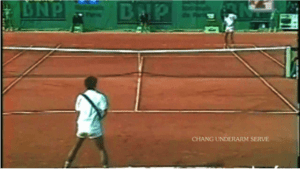 Serving underarm in tennis is still within the rules, despite several incidences over the years, but it is widely considered to be unsportsmanlike and is booed by crowds all over the world.
The most famous incidence of this was when 17-year old Michael Chang was taking on World Number 1 Ivan Lendl in the 4th round in the 1989 French Open. The young American was exhausted and suffering from cramp at the time, and used the trick (along with several others including looping the ball high, and standing comically close to the net when returning serves) in an attempt to change the rhythm of play and break Lendl’s concentration.
It certainly worked, with Lendl losing his cool, his temper, and eventually, the match.
Ayrton Senna’s crash at Japan Grand Prix, October 1990
It was tight at the end of the 1990 Formula 1 Championships, and for the third year in a row it was between Ayrton Senna and Alain Prost for the title going into the final race at Suzuka.
If both drivers crashed out of the race, Senna would go on to win. What happened next? Yep, you guessed it – on the first corner Senna tried to take Prost on the inside with the two crashing after just 9 seconds.
After they came to a halt, Senna asked into his radio, “They’re not stopping the race, are they?”. They didn’t, and he was crowned the 1990 world champion.
Trevor Chappell’s underarm bowling, February 1981
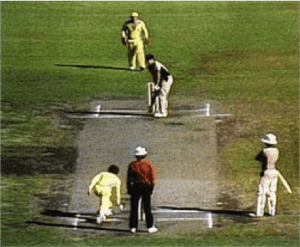 Referenced by England Head Coach Eddie Jones after their win over Italy, Australia was playing New Zealand in a one-day test series that was tied 1-1 leading up to the final match. With one ball remaining, and New Zealand needing to hit a 6 to win, Trevor Chappell was instructed by his brother and captain Greg to bowl the ball underarm to prevent the NZ batsman Brian McKechnie from hitting his required score.
Bowling underarm was within the laws of cricket at the time, but caused chaos on the pitch with the batsman walking off in disgust, and the Prime Minister of New Zealand at the time Robert Muldoon describing it as “the most disgusting incident I can recall in the history of cricket”.
Badminton, London 2012 Olympic Games
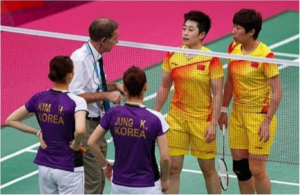 London 2012, arguably the greatest sporting summer of all time. Except in badminton. Boos rang around the Excel Arena, as players from China, South Korea and Indonesia attempted to lose group matches on purpose in an attempt to manipulate the draw.
It started with the Chinese number 1 pairing, who were looking to avoid their 2nd pairing from their own country in the next round. This led to the South Koreans and Indonesians they were playing against mimicking their tactics, resulting in almost every serve being hit into the net and a raft of shots being missed on purpose.
Thankfully, all 8 players were swiftly disqualified for their unsportsmanlike conduct.
Overall, the many complexities of the laws in sports across the board means there are always likely to be loopholes that can be exploited. Opinions will vary, but some can be described as clever, (Italy’s ‘tactics’ and Lealiifano’s quick drop goal), some unsporting (Trevor Chappell and Michael Chang’s antics), and some simply downright cheating (see the disgraced Badminton players from London 2012).
Sometimes these actions expose to lawmakers areas of sports that need to be changed, meaning it takes a certain amount of bravery to attempt them in any form. As some people might say, rules are there to be challenged, tested, and sometimes even broken.