







 Performance Communications | أغسطس 8, 2017

In a bid to tackle the air quality crisis, the UK Government has recently announced plans to ban Internal Combustion Engine (ICE) vehicles by the year 2040.
Doctors have now warned us that nitrogen oxide is causing as many as 40,000 premature deaths a year and, although nitrogen oxide is more than just an issue for the automotive industry, there is no denying (well… unless you’re Trump) that the ban of ICE vehicles will significantly improve air quality.
The initial announcement was met with mixed opinions with some people concerned that, by banning ICE vehicles, you’re simply swapping one problem for another. There are still many sceptics who doubt how viable the e-revolution is in the current climate, with the UK’s charging infrastructure still in its early stages.
That’s not to say that we won’t have the power in 20 years. Alongside the rise in EVs, alternative energy solutions including home energy storage technology are emerging in parallel to help address the rising demand for clean energy.
Of course, the same sceptics of the ban will be casting their minds back to 2001, when the Government introduced tax breaks for diesel cars, because they emitted less CO2 than petrol cars. Since then, research has revealed that although lower in CO2, diesel cars emit more nitrogen oxide, which is suggested to be even more harmful. Oops.
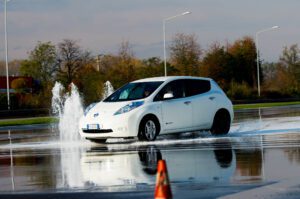 A similar scenario seems unlikely and the ban is indicative of a shift that is well underway in the automotive industry. We’re already seeing a rapid growth in EVs, with major manufacturers including Nissan and Tesla announcing new, advanced technologies that are driving consumer buy-in. In fact, you could argue that even without the ban, we would still be looking at a very similar 2040.
Several leading car manufacturers have already declared ambitious plans to tackle the air pollution crisis. Volvo recently announced that all its cars will be either electric or hybrid by 2019. Given that the brand doesn’t yet make a 100% electric vehicle, that’s a bold claim but perhaps not an unrealistic one.
It’s clear to see that the growing environmental and health fears we’re facing have galvanised innovation and ambition in the industry and, while we can’t see 20 years into the future, we’re hopefully heading in a positive direction.
With automotive manufacturers making leaps and bounds with electric technology, plus the growth in smart renewable energy, there’s no reason why an electric future can’t be achievable.