





 Performance Communications | سبتمبر 12, 2017
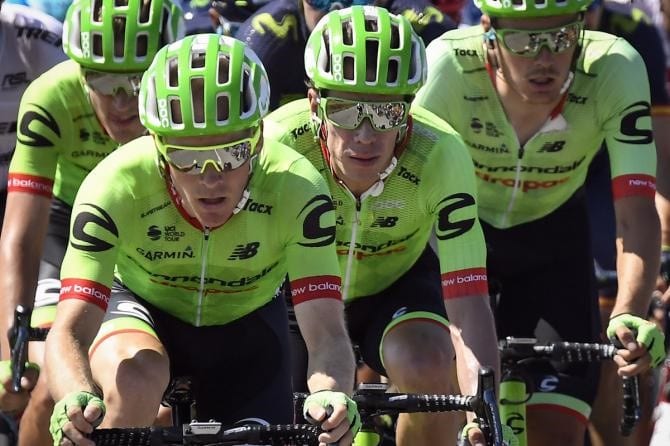
It is fantastic news that Cannondale has a new sponsor for 2018 in the shape of Education First, but the fact that disaster has been averted in this instance must not detract from the stark reality that the sport’s commercial model remains broken.
It is amazing that such an inequitable status quo has lasted until now. How long until we hear the next World Tour team is teetering on the brink as a result of a sponsor shifting its strategy? How many times must we hear that the sport’s commercial framework is fragile before action is taken to fix it? It is a broken record…change it now, please!
From where I stand, there is only one solution – which is that ASO (organisers of Tour de France & Vuelta a Espana) and RCS (Giro d’Italia), along with other key event stakeholders, must sit down with the teams and agree a mutually beneficial way forward, building from the cornerstone of a revenue share for the sport’s Grand Tours which together account for the majority of cycling’s commercial revenues.
As it stands, TV revenues from these events are not shared by organisers. Sponsorship remains the teams’ one significant revenue stream and inevitably every sponsorship, however committed, is finite.
But ASO and RCS don’t want to share the spoils. They are very happy with the model as it stands…and why wouldn’t they be?
However, there can be no race without the star riders, so armed with a sleeve full of aces, the teams must act together to force a compromise; to provoke debate; to forge a new deal.
Faced with the threat of universal rider withdrawal from the Tour de France, the sport’s golden goose, ASO will have no option but to listen and engage…and if they listen, RCS will too.
The recent creation of VELON to represent the World Tour teams’ interests and improve the fan experience has already demonstrated that the teams are able to work effectively together.
When challenged about how they use the considerable Tour de France TV revenues for the good of the sport, ASO will point to the fact that prestigious stage races like the Critérium du Dauphiné and Paris-Nice only still exist as a result of its commercial intervention.
However, if as part of a new deal, the teams and the organisers were to agree a calendar of events that they would all be bound to compete in, all promote and all share revenues from, then what better way to preserve a secure future for all the sport’s crown jewels.
The situation is not unlike that which existed in Formula One before the first Concorde Agreement was struck – between warring FISA (rule makers) and FOCA (teams) in 1981. Several races had to be cancelled and global sponsors threatened withdrawal, before the landmark 13-hour meeting, orchestrated by Bernie Ecclestone and Max Mosely – achieved an equitable and more productive way forward for all parties.
The reluctance of individual teams and riders to take action is understandable. In isolation, rebellious teams can easily be replaced on the start line, and thereby lose their sponsors’ biggest shop window of the year. Riders are typically on short contracts, so as a breed are disinclined to make any kind of fuss.
The start list for this year’s Tour de France, staged across a country which is no stranger to strikes, featured two French teams and no less than thirty nine French riders. So what are they waiting for? Aux armes, citoyens!
In terms of an honest broker, there is surely a role here for the UCI. If the new President Lappartient doesn’t have a taste for it then perhaps Bernie and Max can be tempted back into the fray?